
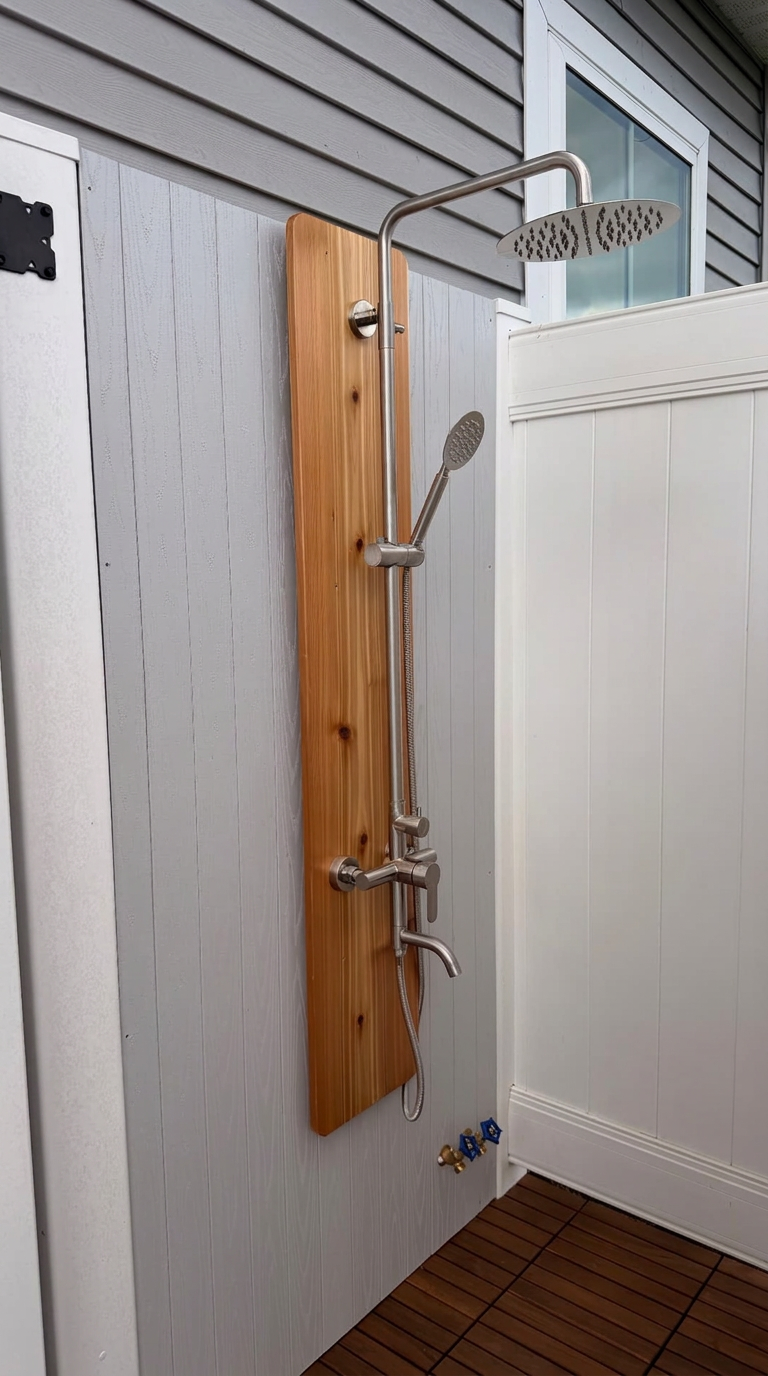
What Is the Best Material for an Outdoor Shower Near the Ocean?
Cedar, exterior-rated PVC, and suitable composite products are all options for outdoor shower construction in coastal Delaware.
Cedar offers a natural appearance but requires ongoing care. PVC and certain composite products can reduce refinishing requirements. For exposed hardware, appropriately specified stainless steel—often grade 316—is worth considering because coastal salt exposure increases corrosion risks.
The best combination depends on your home's location, design, maintenance preferences, and budget.
For homeowners in Rehoboth Beach, Lewes, Bethany Beach, and surrounding coastal communities, material selection deserves particular attention.
An outdoor shower must withstand repeated water exposure, seasonal weather, humidity, and—in locations close to the ocean—airborne salt.
Choosing materials based only on appearance can result in avoidable maintenance and premature deterioration.
Here's how the most common options compare.
Quick Comparison: Outdoor Shower Materials
| Material | Main Advantage | Maintenance | Best Application |
|---|---|---|---|
| Western Red Cedar | Natural coastal appearance | Regular cleaning; refinishing as needed | Enclosures and privacy walls |
| Composite | Reduced wood-finishing requirements | Cleaning and inspection | Approved decking or enclosure applications |
| Cellular PVC | Resistance to wood decay | Cleaning; inspect joints and fasteners | Compatible exterior trim and enclosure systems |
| 316 Stainless Steel | Improved resistance to salt-related corrosion | Periodic cleaning and inspection | Exposed hardware and appropriate fixtures |
| Textured Stone or Concrete | Durable, solid flooring options | Surface cleaning and drainage maintenance | Properly designed shower floors |
Important: Not all materials marketed for decks, fences, or exterior trim are approved for outdoor shower enclosures. Always check the product's intended use and installation instructions.
Is Cedar Good for Outdoor Showers in Delaware?
Yes. Western red cedar can be a suitable material for outdoor shower enclosures because its heartwood offers natural decay resistance and a distinctive appearance.
However, it is not maintenance-free and must be installed with appropriate moisture management.
Cedar is often associated with traditional coastal architecture.
Its natural texture and warm color can complement beach cottages, wooden decks, and homes with natural exterior finishes.
Advantages of Cedar
1. Natural appearance
Cedar produces a warm, traditional look that works well with many coastal home designs.
2. Natural decay resistance
Western red cedar heartwood contains naturally occurring compounds that contribute to decay resistance.
However, resistance varies with the wood's quality, heartwood content, exposure, and installation conditions.
3. Design flexibility
Cedar can be used for privacy screens, vertical slats, enclosure walls, and doors.
4. Attractive weathering
When left unfinished, cedar typically changes toward a gray appearance as sunlight and weather affect the surface.
Does Cedar Require Maintenance?
Yes.
Repeated exposure to moisture and sunlight can change the wood's appearance and affect surface finishes.
Homeowners who prefer cedar's original color should consider a suitable exterior finishing system and periodic maintenance.
The USDA Forest Service has documented how exterior wood-finish performance depends on coating type, wood surface, and exposure conditions.
Source: https://research.fs.usda.gov/treesearch/36613
When Should Homeowners Choose Cedar?
Cedar may be suitable when:
- Natural wood aesthetics are important.
- The outdoor shower complements a traditional beach home.
- The homeowner accepts periodic maintenance.
- Appropriate ventilation and drainage can be incorporated.
Bottom line: Cedar is a practical aesthetic option for coastal outdoor showers, provided homeowners understand its maintenance requirements.
Is Composite Better Than Wood for an Outdoor Shower?
Composite can be a lower-maintenance alternative to natural wood, but it is not automatically better for every outdoor shower.
Its suitability depends on the specific product, application, structural support, and installation requirements.
Many composite products combine recycled plastics, wood fibers, or other materials.
Unlike natural wood, many composite products don't require routine staining to maintain their manufactured appearance.
Advantages of Composite
Reduced refinishing
Many composite products eliminate the need for traditional wood staining.
Design flexibility
Composite products are available in different colors, textures, and finishes.
Moisture resistance
Some composite decking products are specifically designed for applications involving repeated water exposure.
For example, Trex identifies compatible composite decking as an option for outdoor shower flooring.
Source: https://www.trex.com/deck-ideas/5-outdoor-shower-design-ideas/
What Are the Disadvantages?
Composite is not maintenance-free.
Depending on the product, homeowners should consider:
- Thermal expansion and contraction.
- Surface temperatures in direct sunlight.
- Manufacturer-specified spacing and fastening.
- Cleaning requirements.
- Whether the product is approved for vertical enclosure applications.
Composite decking also should not automatically be treated as structural framing.
When Does Composite Make Sense?
Composite can be appropriate for homeowners who want a contemporary appearance and prefer to avoid periodic wood refinishing.
However, product selection should be based on its actual intended application—not simply the fact that it is labeled composite.
Bottom line: Composite is worth considering for certain outdoor shower components, but the installation should follow the manufacturer's specifications.
Is PVC a Good Material for Outdoor Shower Enclosures?
Exterior-rated cellular PVC can be a useful option for outdoor shower trim and compatible enclosure systems because it does not decay like natural wood.
However, appropriate structural support, fastening, and allowance for temperature movement remain essential.
PVC building products are often selected for exterior areas where homeowners want a painted or clean-looking finish without conventional wood maintenance.
Advantages of PVC
Resistance to wood decay
Cellular PVC is not susceptible to the same biological decay mechanisms as natural wood.
Coastal appearance
White and light-colored PVC products can complement coastal-style homes.
Reduced refinishing
Some products are manufactured with finishes that do not require regular staining.
What Are the Limitations?
PVC products vary substantially.
A PVC trim board should not automatically be assumed suitable for unsupported privacy walls, doors, or structural applications.
Temperature changes can also affect dimensions.
Manufacturers may specify particular fasteners, expansion gaps, and installation procedures.
When Is PVC Worth Considering?
PVC may suit homeowners who prefer:
- A clean, contemporary appearance.
- Reduced wood refinishing.
- Light-colored enclosure designs.
- Compatible, manufacturer-approved exterior systems.
Bottom line: PVC can be a useful material, but the exact product must match the intended application.
What Type of Stainless Steel Is Best for an Outdoor Shower Near the Ocean?
Grade 316 stainless steel is often preferable to grade 304 for exposed coastal hardware because it provides improved resistance to chloride-related corrosion.
However, even grade 316 can corrode in aggressive marine conditions.
This distinction matters for Delaware beach homes.
Coastal air may carry salt particles that settle on exposed metal surfaces.
Over time, these deposits can contribute to corrosion, especially where moisture remains trapped.
Why Does Stainless Steel Grade Matter?
Grade 304 is widely used for many applications.
Grade 316 contains molybdenum, which improves resistance to certain forms of chloride-related corrosion.
The Nickel Institute identifies 316 stainless steel as commonly suitable for coastal architectural applications while noting that more aggressive environments may require additional protection or different alloys.
Source: https://nickelinstitute.org/media/1613/11024-guidelines-for-corrosion-prevention.pdf
Outdoor Shower Components to Consider
- Shower fixtures.
- Door hinges.
- Screws and fasteners.
- Mounting brackets.
- Handles and other exposed hardware.
An item described as having a "stainless steel finish" is not necessarily made entirely from stainless steel.
Homeowners should verify the actual material specification rather than relying on appearance.
Does Stainless Steel Require Maintenance?
Yes.
Even corrosion-resistant stainless steel benefits from cleaning to remove salt deposits and accumulated contaminants.
Bottom line: For outdoor showers exposed to coastal salt air, corrosion resistance should be considered when selecting every metal component—not just the showerhead.
What Is the Best Flooring for an Outdoor Shower?
The best outdoor shower flooring provides secure footing, appropriate drainage, and materials suitable for repeated wet exposure.
Common options include exterior-rated wood decking, compatible composite decking, textured concrete, and suitable stone surfaces.
Each has different advantages.
Wood Decking
Wood can complement natural shower enclosures.
However, spacing, drainage, drying potential, and regular maintenance are important.
Composite Decking
Compatible composite decking may reduce refinishing requirements.
Homeowners should confirm wet-area suitability and consider surface temperature and traction.
Textured Concrete
Concrete can create a durable shower surface.
Proper slope, surface texture, drainage, and installation are essential.
Stone
Stone may complement a premium outdoor design.
However, not every stone or finish provides suitable traction when wet.
Certain surfaces may also require sealing or specialized maintenance.
Why Drainage Matters
A shower should not allow water to accumulate against the house or create persistent wet areas.
Drainage design may depend on:
- The existing ground conditions.
- How frequently the shower will be used.
- Plumbing connections.
- The property's drainage arrangement.
- Applicable local requirements.
Bottom line: Flooring selection should account for safety and drainage before appearance.
What Materials Work Best for Delaware's Coastal Climate?
There is no single material combination that is ideal for every coastal Delaware property.
However, homeowners should generally consider three environmental factors.
1. Salt-Air Exposure
Properties closer to the ocean or exposed to prevailing coastal winds may experience greater salt deposition.
Corrosion-resistant fixtures and fasteners deserve particular attention.
2. Moisture and Humidity
Outdoor shower enclosures regularly become wet.
Materials and construction details should allow water to drain and surfaces to dry.
3. Seasonal Freezing
Delaware experiences freezing temperatures during winter.
Outdoor shower plumbing may require seasonal draining, freeze protection, or other appropriate winterization measures.
The right approach depends on the plumbing configuration.
Material durability alone cannot compensate for poorly designed drainage or unprotected plumbing.
Which Outdoor Shower Material Should You Choose?
The decision becomes easier when homeowners identify their main priority.
For a natural coastal appearance: Consider western red cedar.
For reduced wood refinishing: Evaluate suitable composite or exterior-rated PVC systems.
For exposed coastal hardware: Consider appropriately specified corrosion-resistant metals, including 316 stainless steel where suitable.
For flooring: Prioritize slip resistance, drainage, and product suitability.
A single outdoor shower may use several materials.
For example, a homeowner might prefer cedar privacy walls, corrosion-resistant hardware, and a compatible composite floor.
The components should be selected as a complete system rather than independently.
Frequently Asked Questions About Outdoor Shower Materials
What Is the Most Low-Maintenance Material for an Outdoor Shower?
Compatible exterior-rated PVC and certain composite products generally require less refinishing than natural wood.
However, they still need cleaning and periodic inspection.
The specific product and installation determine maintenance needs.
Can Cedar Outdoor Showers Last Near the Ocean?
Yes, cedar can perform well in exterior applications when appropriately selected, installed, and maintained.
Longevity depends on exposure, moisture management, wood quality, and maintenance.
A universal lifespan should not be assumed.
Will Stainless Steel Rust Near the Beach?
Stainless steel can develop staining or corrosion in coastal environments.
Grade 316 generally offers improved resistance to chloride-related corrosion compared with grade 304, but neither is completely immune.
Are Composite Materials Waterproof?
Performance varies by product.
Some composite decking products are designed for frequent water exposure, but that does not mean every composite product is waterproof or suitable for shower walls and enclosures.
Is an Outdoor Shower a Good Addition to a Delaware Beach House?
An outdoor shower can make rinsing off sand and saltwater more convenient and help keep beach debris out of the home.
Its usefulness depends on the property's layout, intended use, and homeowner preferences.
Should I Choose Materials Before Designing the Outdoor Shower?
Usually, the layout and material selection should be developed together.
Privacy requirements, drainage, plumbing, structural support, and aesthetics can all affect the materials that are appropriate.
Sources and Further Reading
-
USDA Forest Service — Service Life of Finishes on Western Red Cedar https://research.fs.usda.gov/treesearch/36613
-
USDA Forest Service — Wood Finishing Handbook https://research.fs.usda.gov/treesearch/62269
-
Nickel Institute — Guidelines for Corrosion Prevention https://nickelinstitute.org/media/1613/11024-guidelines-for-corrosion-prevention.pdf
-
Trex — Outdoor Shower Design and Material Considerations https://www.trex.com/deck-ideas/5-outdoor-shower-design-ideas/
-
Trex — Installation Guides https://www.trex.com/customer-support/trex-owners/downloads/